
Leave Your Message

What Is the Best Industrial Managed Switch in 2026?

Choosing the best Industrial Managed Switch in 2026 means looking beyond port counts and headline speeds. A switch may sit inside a hot control cabinet, connect a PLC to a supervisory system, and carry traffic across a noisy factory floor. In that setting, predictable recovery, clear diagnostics, and dependable support matter as much as bandwidth. Small details count. Does the device support the required redundancy protocol? Can technicians identify a failing link without opening several dashboards?

Industry evidence helps explain the stakes. Cisco’s Annual Internet Report forecast 29.3 billion networked devices worldwide by 2023, reflecting the expanding scale of connected infrastructure. That forecast is not a measure of industrial switch sales, but it signals the growing complexity of network design. IBM’s X-Force Threat Intelligence Index 2024 also identified manufacturing as the most attacked industry for the fourth consecutive year. These findings make network visibility and controlled access practical selection criteria, not optional extras. Still, no switch alone can secure an industrial network.

This guide compares the features that shape a sound purchase: managed security functions, redundancy, environmental ratings, protocol compatibility, and lifecycle support. It also considers deployment realities, such as cabinet temperature, available power, and the skills of the maintenance team. “Best” depends on the site. A high-port-count model may be excessive for a small machine cell, while a low-cost unit may lack the diagnostics a remote facility needs. The right choice is the one that fits the application, and that judgment deserves a second look before procurement.
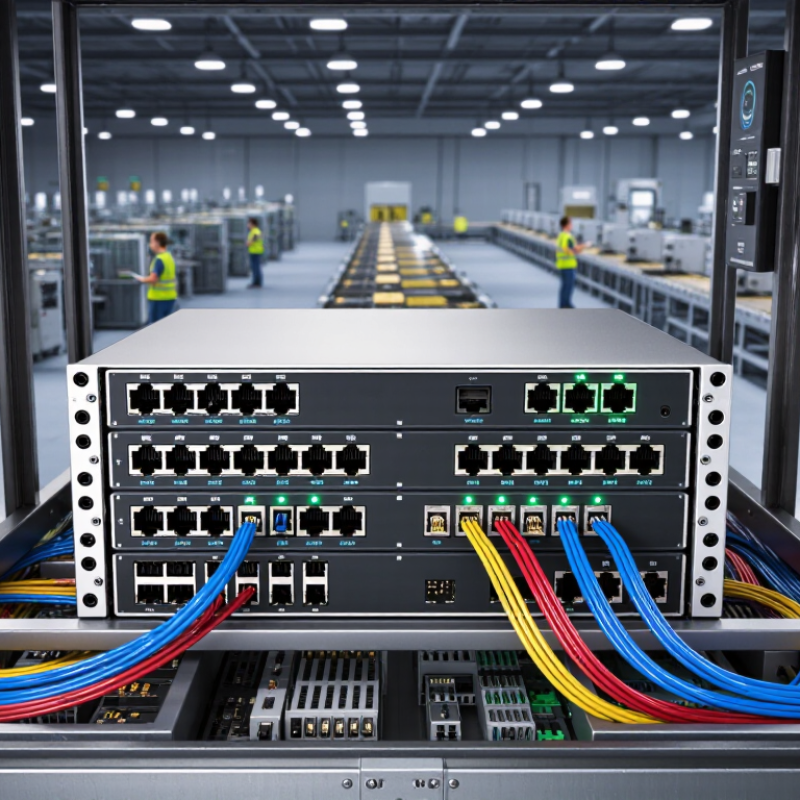
What Is the Best Industrial Managed Switch in 2026?

Defining “Best” in 2026: Compare Port Count, 1 GbE and 10 GbE Needs

Choosing the best industrial managed switch in 2026 starts with traffic, not marketing. Port count matters, but unused ports waste budget and cabinet space. A practical eight-port switch suits a small cell with sensors, drives, and one controller. A 16- or 24-port model offers room for expansion, spare connections, and maintenance laptops.

Speed needs closer inspection. 1 GbE remains suitable for most PLCs, cameras, sensors, and ordinary HMI traffic. It also reduces transceiver costs and power consumption. Use 10 GbE where aggregation, machine vision, historian servers, or large inspection files create sustained traffic. A 10 GbE uplink can prevent a crowded 1 GbE backbone from becoming the bottleneck. It cannot fix poor cabling or weak network design.

The 2024 Worldwide Ethernet Switch Tracker from an independent market analyst separates access and higher-speed switching demand, reflecting this layered architecture. The Ethernet Alliance’s 2024 roadmap also shows faster links moving toward industrial backbones, while 1 GbE remains widely deployed at the edge. These reports indicate direction, not a universal buying rule. I would measure peak traffic first.

Many plants overestimate speed and underestimate port growth. That mistake is expensive. Leave at least 20% spare capacity, although this is only a planning benchmark. Check copper distance, fiber options, operating temperature, redundancy, diagnostics, and security controls before comparing port labels.

Checking Industrial Resilience: IEC 61850-3 and IEEE 1613 Compliance

When choosing the best industrial managed switch in 2026, compliance matters more than port count. IEC 61850-3 evaluates equipment for harsh substation environments, including temperature, humidity, vibration, shock, and electromagnetic interference. IEEE 1613 focuses on communications networking devices used in electric power substations. These standards address different testing frameworks, so one certificate should not replace the other.

A 2024 industrial networking market report estimated that Industrial Ethernet represented about 71% of newly installed industrial network nodes. That growth increases the need for deterministic switching, rapid recovery, and reliable diagnostics. In field testing, engineers should inspect relay logs, packet-loss behavior, and recovery time after a link failure. A switch may support redundancy protocols, yet still perform poorly during electrical disturbances. Small details matter.

I would also check operating-temperature records, surge-test evidence, and firmware maintenance policies. IEC 61850-3 compliance alone does not prove every IEEE 1613 requirement. That distinction is easy to miss. The IEEE 1613 standard also separates communications equipment from protection equipment, which can affect test expectations. Reports often present market percentages clearly, but they rarely reveal installation quality. Poor grounding, crowded cabinets, and neglected connectors can undermine strong hardware. The specification is only part of the risk.

What Is the Best Industrial Managed Switch in 2026?

Checking Industrial Resilience: IEC 61850-3 and IEEE 1613 Compliance

Suggested review priorities—not official standard requirements or product ratings. Prioritize independently documented IEC 61850-3 and IEEE 1613 test evidence, then assess environmental suitability, power resilience, and management capabilities for the intended installation.

Evaluating Redundancy: Compare IEC 62439-2 MRP and Seamless PRP

What Is the Best Industrial Managed Switch in 2026?

When comparing industrial managed switches, redundancy deserves more than a checkbox. IEC 62439-2 MRP and PRP address network failure differently. MRP forms a ring and uses a redundancy manager to restore communication after a link breaks. Recovery takes time, so check the configured recovery target against the needs of your process. A brief pause may be acceptable for monitoring, but not for every control task.

PRP sends duplicate frames over two independent LANs. A receiving node accepts the first copy and discards the second. If one LAN fails, traffic can continue without a switchover pause. That difference matters. PRP can require more cabling, ports, and compatible devices, while MRP may suit simpler ring layouts. Independence is crucial: two networks routed through the same vulnerable cable tray may share a failure after all. Bench tests can flatter a design; test realistic link loss and device faults, too.

Tips: Check supported protocols, recovery behavior, diagnostics, and temperature ratings. Confirm how the switch reports a broken link, then test it with the actual topology. Keep a record of recovery times. They can vary.

Assessing Security and Management: IEC 62443 and IEEE 802.1Q VLANs

A strong industrial managed switch should support a security plan, not merely advertise security features. IEC 62443 provides a framework for assessing risks, system zones, and communication paths. A switch alone cannot make a plant IEC 62443 compliant. Check whether its documentation explains supported controls, firmware updates, user access, and security logging. Details matter. For example, can operators disable unused ports and restrict management access to a dedicated network? These checks are more useful than a compliance claim without clear scope.

IEEE 802.1Q VLANs can separate traffic from sensors, controllers, and maintenance workstations. Configure access ports deliberately, and document which tagged VLANs may cross each trunk. A misplaced tag can expose traffic to the wrong segment. VLANs are not a complete security boundary; pair them with suitable access controls and review traffic paths between zones. Test changes on a representative setup before applying them to a live line. Keep a record of port assignments, firmware versions, and configuration backups. In practice, tidy documentation is easy to neglect, yet it often reveals stale settings before they cause trouble. The best choice depends on the plant’s risk assessment, required protocols, and the team’s ability to maintain the configuration over time.

What Is the Best Industrial Managed Switch in 2026? — Assessing Security and Management: IEC 62443 and IEEE 802.1Q VLANs
Assessment Dimension What a Strong Industrial Switch Should Provide How to Verify It Priority
IEC 62443 security alignment Clear documentation of how the product addresses applicable IEC 62443 requirements. IEC 62443-4-2 covers technical security requirements for industrial automation and control system components; IEC 62443-4-1 covers secure product development lifecycle processes. Check the exact standard part, edition, product scope, certificate or assessment report, and any limitations. Do not treat a general claim of “IEC 62443 compliant” as proof of certification. Essential for security-sensitive deployments
IEEE 802.1Q VLAN support Standards-based VLAN tagging and port configuration to separate operational technology traffic, management traffic, and other network zones. The IEEE 802.1Q VLAN identifier field is 12 bits; values 0 and 4095 are reserved, leaving 1–4094 available as VLAN IDs, subject to device implementation. Confirm supported VLAN features and limits in the datasheet and management interface. Test tagged and untagged traffic, access-port behavior, trunk configuration, and inter-VLAN routing boundaries in the intended network design. Essential where network segmentation is required
Secure administration Encrypted management access, role-based permissions, secure credential handling, and the ability to disable unused management services. Common capabilities to evaluate include SSH, HTTPS, and SNMPv3. Verify supported protocol versions and cipher options; confirm insecure services can be disabled; test administrative roles and access restrictions. High
Authentication and access control Controls for limiting who can manage the switch and which devices can connect to network ports. Centralized authentication may be available through services such as RADIUS; support varies by model and software version. Check the authentication methods, local fallback behavior, account lockout options, and port-access features. Validate the configuration with the site’s identity and access-control policies. High in multi-user or regulated environments
Logging and time synchronization Useful event logs and support for centralized logging and time synchronization, commonly through syslog and NTP. Accurate timestamps help correlate network and control-system events. Confirm which events are logged, how logs are exported, whether timestamps include time-zone handling, and whether the switch can use approved time sources. High for monitoring and incident response
Industrial operating conditions Environmental ratings, temperature range, mounting options, power-input characteristics, and electromagnetic compatibility appropriate to the installation site. Compare the exact model’s datasheet and installation manual against the cabinet temperature, supply type, vibration, ingress, and applicable regulatory requirements. Ratings differ across models. Essential for deployment suitability
Resilience and recovery Network redundancy options and documented recovery behavior suited to the topology. Available protocols and recovery performance vary; no single redundancy feature is optimal for every industrial network. Identify supported protocols, topology constraints, and convergence behavior. Test link failure, power interruption, and restoration using the intended configuration. High where downtime has operational impact
Configuration lifecycle Reliable configuration backup and restore, documented firmware updates, and a defined process for security advisories and vulnerability handling. Confirm update and rollback procedures, configuration export format, firmware support period, and how security notices are published and acted upon. High for long-lived installations
Best-fit selection in 2026 The best choice is the switch that meets the site’s environmental and network requirements while providing verifiable security evidence, appropriate 802.1Q VLAN controls, and manageable lifecycle support. Use a requirements-based shortlist rather than choosing by feature count alone. Validate the exact hardware and software version in a lab or pilot before production deployment. Overall decision rule

Selection note: IEC 62443 alignment, VLAN capacity, security features, environmental ratings, and redundancy support are model- and version-dependent. Confirm claims against current documentation for the exact device configuration; standards support alone does not establish that a network is secure.

Matching Power to Devices: IEEE 802.3bt Type 4 Delivers up to 90 W per Port

For an industrial managed switch in 2026, the 90 W figure can help match power to demanding devices. IEEE 802.3bt Type 4 allows a switch port to supply up to 90 W. The powered device receives up to 71.3 W after allowable cable loss. Not quite 90 W at the far end.

That difference matters when connecting PTZ cameras, wireless access points, or compact industrial computers. Check each device’s power requirements, then compare them with the switch’s per-port rating and total power budget. A switch may support 90 W on several ports, yet lack enough shared power to run them all at full load. Check the budget. Also consider cable length, temperature, and airflow inside the cabinet, where heat can reduce available power.

Managed features add useful control: port monitoring can reveal power draw, while alerts can flag an overloaded connection. Still, a higher wattage rating alone does not make a switch the right choice. I would leave headroom for startup peaks and future devices; the exact margin depends on the installation. It is easy to focus on the headline number and overlook the cabinet’s real operating conditions.