How to Choose the Best Poe Extender for Your Network Needs?
Selecting the right Poe extender can significantly enhance your network's performance. Poe extenders allow devices to draw power and data over long distances. This is vital for locations that require reliable connections away from the main power source.
Understanding your specific requirements is key. Consider the distance you need to cover and the device types you plan to connect. Not all Poe extenders are equal; some focus on speed, while others prioritize power delivery. Expertise in these aspects can prevent costly mistakes later.
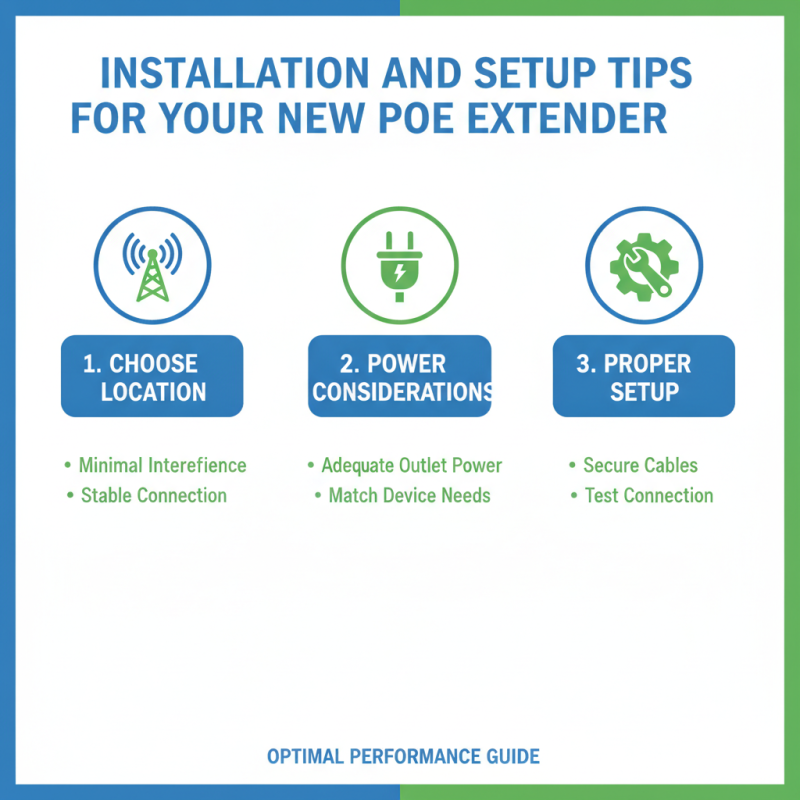
Installation is another critical aspect. Many users overlook this step, leading to complex setups. Seek reliable brands to ensure both quality and efficiency. Investing in a quality Poe extender is an investment in your network's reliability and performance for the future.
Understanding the Basics of PoE Extenders and Their Functionality
Power over Ethernet (PoE) extenders play a vital role in modern networks. They allow for the transmission of power and data over long distances using standard Ethernet cables. Understanding their functionality is essential for optimal network performance. PoE extenders are particularly useful in locations where the distance exceeds the typical 100-meter limit of Ethernet cables. They amplify the signal, ensuring reliable connectivity, even in challenging environments.
When selecting a PoE extender, consider the power requirements of your devices. Different extenders support varying power levels. If your devices require higher wattage, you need an extender that can accommodate this demand. Additionally, the number of devices connected impacts the choice. A multi-port extender can support several devices simultaneously, enhancing flexibility. However, it's crucial to assess the total load; exceeding the extender's capacity might lead to network issues.
Consider the installation environment too. Outdoor extenders need weatherproofing features. Indoor devices may require less rugged design. Reflect on the future needs as well. Investing in a more capable extender could save future upgrade costs. Navigating these choices can be daunting. Each scenario has its own challenges, and not all solutions fit every situation. A thoughtful approach enhances both immediate performance and long-term reliability.
How to Choose the Best Poe Extender for Your Network Needs?
| Feature |
Description |
Importance |
| Port Power |
Amount of power each port can deliver. |
Critical for ensuring your devices work without issues. |
| Distance |
Maximum distance the PoE extender can support. |
Essential for determining placement of devices. |
| Compatibility |
Supported PoE standards (e.g., IEEE 802.3af, 802.3at). |
Important to ensure your devices can connect properly. |
| Cooling System |
Method of preventing overheating. |
Vital for long-term reliability and performance. |
| Data Rate |
Speed of internet data transmission through the extender. |
Significant for maintaining a fast network connection. |
| Installation Ease |
How straightforward it is to set up the extender. |
Key for reducing setup time and complexity. |
Identifying Your Network Requirements Before Choosing a PoE Extender
When selecting a Power over Ethernet (PoE) extender, understanding your network requirements is essential. Start by assessing the distance between your devices. PoE extenders work effectively within specific ranges. Do you need to connect devices more than 100 meters away? If so, look for extenders designed for long-range applications. This ensures signal integrity over longer distances.
Next, evaluate the power needs of your devices. Different PoE standards deliver varying power levels. Are your devices high-demand, like security cameras or wireless access points? If they are, ensure your extender can handle their power requirements. Insufficient power leads to performance issues.
Then, consider the installation environment. Is it indoors or outdoors? Harsh conditions may require weatherproof extenders. Check compatibility with your existing network setup. Some extenders offer additional features, like repeaters or redundancy options. Think about your future needs, too. Will you need to expand your network? Be mindful of these factors for effective network planning. Reflect on past choices. Did you overlook specific requirements? Learning from these experiences helps refine your decision-making process.
Key Features to Consider When Selecting a PoE Extender
When selecting a PoE extender, it's essential to consider several key features to ensure optimal performance. Power delivery is one critical aspect. Most extenders support various power levels, ranging from 15.4W to 60W. Choosing the right power rating can significantly impact devices like security cameras or access points. Research indicates that 70% of network failures stem from inadequate power supply. Therefore, thorough research is necessary.
Another crucial feature is the range of the extender. Some models can boost signals up to 800 meters, which is beneficial for expansive properties. The IEEE 802.3 standards provide guidelines on maximum distances. However, exceeding these may lead to signal degradation. Users should also evaluate the environmental conditions where the extender will be installed. For instance, outdoor extenders need to endure extreme temperatures and moisture.
Lastly, compatibility with existing network infrastructure is vital. Some extenders may not work seamlessly with older equipment, leading to performance issues. It's essential to verify specifications against current network needs. A study finds that nearly 60% of network downtime is linked to compatibility problems. Thus, extensive testing before deployment can mitigate potential risks. By focusing on these key features, one can make a more informed choice.
Comparing Different Types of PoE Extenders for Optimal Performance
When selecting a PoE (Power over Ethernet) extender, it's crucial to compare different types to determine which best suits your network needs. Various extenders exist, such as standard, high-power, and industrial models. Each has its unique features and optimal application environments. Standard extenders are suitable for basic connectivity. High-power extenders cater to devices needing more power, like IP cameras. Industrial models excel in harsh environments, providing rugged reliability.
Consider a few tips before purchasing a PoE extender. First, evaluate your device's power requirements. Oversizing or undersizing the extender can lead to performance issues. Secondly, inspect the maximum transmission distance. Ensure the extender can cover the distance needed for your setup. Lastly, think about environmental factors. Some extenders can operate in extreme temperatures while others cannot.
Another point to reflect on is compatibility. Not all extenders support every PoE standard. Check the specifications of your devices to ensure smooth integration. It's also wise to consider future needs. As your network expands, you may require additional capabilities. Selecting an extender that can adapt to evolving requirements ensures long-term effectiveness. Making informed decisions now can save time and resources down the line.